Basic Kayak Coursein Rishikesh
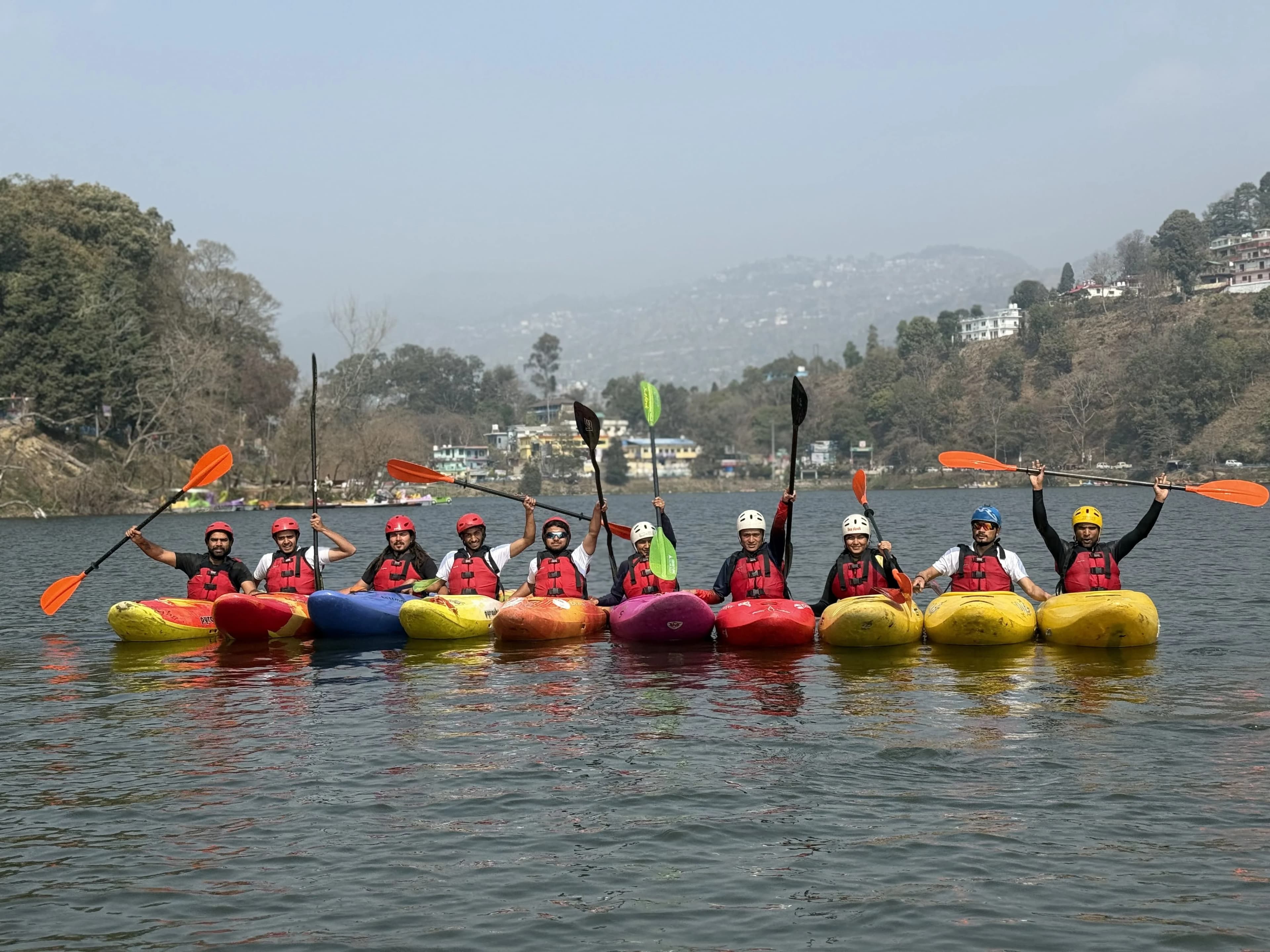
Four mornings on the Ganga that take you from never having sat in a kayak to running a Class II rapid on your own. You'll learn to capsize safely, steer in current, catch eddies and roll back up, with no more than five students per instructor.
₹3,499/dayper person
₹13,996 for the full 4 days
- Duration
- 4 days
- Grade
- Up to Class II
- Group
- 2-5 per instructor
- Route
- Shivpuri → NIM Beach
- Season
- Mid-September to end of June
Overview
What the course covers
Most people who sign up for this course have never sat in a kayak. Four mornings later they're picking their own line down a Class II rapid on the Ganga while their instructor watches from the eddy below. Every session builds on the one before, so nothing new is asked of you until the last skill feels easy.
We start on the riverbank, not in the water. You'll learn how the boat turns when you lean it, how to hold the paddle and how the current moves around rocks. Then comes the skill that takes away most of the fear: the wet exit. You tip the boat over on purpose and slide out, again and again, until being upside down is boring rather than scary.
By the second morning you're on gently moving water, learning to catch eddies (the calm water behind rocks) and to cross the current without drifting downstream. We also start the Eskimo roll in a calm pool, the move that flips you upright without leaving the boat. Many students land their first roll that day.
On the third morning you run your first real rapid, then a 3–4 km mini-trip downstream. The fourth morning is for practising the roll in moving water and a final, longer run where your instructor talks less and less. You leave with a certificate and the skills to keep paddling.
The school provides the boat, paddle, spray deck, helmet and life jacket, plus a wet suit and booties in winter. A safety kayaker is on the water during every river session.
Day by day
Itinerary
- 1
Morning 1 — Learn the boat, then learn to fall out of it
Riverbank lesson first: how a kayak is built, how to sit, the forward and sweep strokes, and why water piles up and swirls around rocks. Then into flat water to practise steering and the wet exit. Expect to capsize on purpose five to ten times. By lunch it feels normal.
- 2
Morning 2 — Moving water and your first roll
We move to an easy Grade I–II stretch near the training site. You'll practise peeling in and out of eddies and ferrying across the current. Both feel awkward at first and then suddenly click. In the second half, your instructor stands beside you in calm water while you work on the Eskimo roll.
- 3
Morning 3 — Your first Class II rapid
Your instructor waits below the rapid and the safety kayaker sits above it. You scout the water, choose a line and paddle it using the eddies and ferries from yesterday. After that comes a 3–4 km mini-trip downstream, where you're paddling continuously instead of drilling one skill at a time.
- 4
Morning 4 — Roll in current, then run it solo
We practise the roll again, this time in moving water, which is the version that matters on a real river. Then comes a longer final Class II run. Your instructor gives fewer and fewer directions until you're reading the water yourself. You get your completion certificate at the take-out.
Good to know
When classes run
8–11 AM in summer and 9 AM–12 PM in winter. If water levels allow, we can arrange an afternoon slot.
Clothes
Shorts or leggings that dry fast, a T-shirt or rash vest, and sandals or old trainers you don't mind getting wet. We hand out wet suits in winter.
In your bag
Water, a snack, waterproof sunscreen and some cash for chai at the river. Your phone goes in the instructor's dry bag while you paddle.
Fitness and swimming
Average fitness is fine. You should be relaxed in water and able to swim a little; the life jacket does the rest.
FAQ
Questions, answered
Which kayak course should I choose, 4 days or 7 days?
If you want a taste of whitewater and to run Class II water by yourself, the 4-day course is enough. If you want to reach Class III, learn the combat roll and come back later to paddle on your own, take the 7 days. The longer course is also the better choice if you expect the roll to take you a while.
Can I learn kayaking in Rishikesh with no experience?
Yes. Both courses start on dry land with how to sit, hold the paddle and get out of an upside-down boat. Nobody touches moving water until they're comfortable on flat water.
What time do classes start?
Mornings, for 3–4 hours. We start at 8 AM in the summer months and at 9 AM in winter, when the water is colder.
Where do I stay during the course?
Stay isn't part of the price. Most students book a guesthouse in Tapovan near our office; expect ₹400–₹1,500 a night. We pick you up from the office each morning.
Is swimming required for kayaking?
You need to be comfortable in water and able to swim a little. You'll wear a Type V life jacket the whole time, so you won't sink, but you will end up in the river during wet-exit practice.
Get on the water
Small groups,
limited spots.
Pick a course and you'll book and pay securely on Sea Hawk Adventures, our parent company. Questions first? Call or WhatsApp us.
Book your course
Booking and payment open on seahawkadventures.com.
- Basic Kayak Course4 days · Up to Class II₹3,499/day
- Complete Kayak Course7 days · Up to Class III₹2,999/day
- Kayak Expedition2N / 3D · Grade II – IIIFrom ₹25,000
Accommodation and meals are not included in the courses. The expedition needs at least two days of prior instruction.